

A sound that cannot be confused with anything else. Low, monotonous, oppressive — it’s described as “the humming of a moped.” This is how a Shahed typically sounds — a kamikaze drone that has already become one of the most dangerous symbols of air threat in Ukraine. If previously many people treated air raid alerts with certain contempt, now more and more people realize: ignoring signals is a clear risk to life. Next, we will tell you how to act in a situation when the sound of a Shahed is heard, how to keep a cool mind and protect yourself and your loved ones.
This is not just an instruction, it’s a survival skill. While the Armed Forces and air defense are holding the sky, on the ground each of us must know our algorithm of actions. That’s why it’s important to understand what an early warning system is, how an anti-aircraft searchlight works, why you shouldn’t record drone flights on your phone, and what to do if an attack catches you by surprise — at home, in a car, or on the street.
Civil protection is far from formality. It’s part of our daily security, our personal defense. And the more people know how to act in a critical moment, the fewer will be injured. Further — only specifics. Without unnecessary fear. Without panic. Only what can save lives.
How does a “Shahed” sound? Recognizing the threat.
A Shahed is an unmanned aerial vehicle, or aircraft that moves without pilot control. But it’s also a kamikaze drone that doesn’t collect intelligence data but flies with a clear purpose: to hit, destroy, annihilate. Its main weapon is the silence of night and the effect of surprise. But if you’re attentive, you can hear it.
The sound of a Shahed is described as the humming of a moped, low and monotonous, approaching as if from the night sky. It’s not like an ordinary drone or airplane — there are no sharp fluctuations, only a constant “howling” sound. It’s especially clear to hear during quiet hours — at night or early morning. If there are no other sources of noise in the sky, this sound is impossible not to notice.
In different regions of Ukraine, people have learned to recognize it instinctively. If you suddenly doubt — don’t risk it. Better to take a step toward safety than stand under threat. Remember: in case of doubt, act as if the danger is real. This is the case when excessive caution is completely justified.
What is an early warning system
Long before you hear the sound of a Shahed, systems may already be working in the country that will warn you about the threat. This is the early warning system — a network of technical means, analytics, and observation that allows detecting an air target on approach.
The key part of such a system is radar equipment, thermal imagers, anti-aircraft searchlights, and other sensors that detect objects in the sky. As soon as a Shahed enters the range of such means — information is transmitted to air defense centers and public warning services. It’s thanks to these systems that we hear sirens and have the opportunity to manage to hide.
It’s worth understanding that the early warning system is not magic and not a 100% guarantee, but it’s a powerful tool that gives us an advantage in time. And this time needs to be used correctly. Even a few minutes can mean saving a life. Therefore, timely response to an alarm signal is not really about discipline, but about your survival.
Clear algorithm of actions during an air strike
When a Shahed hits — the blast wave sweeps away everything. Debris pierces concrete, slate, metal. Cars turn into ashes, and apartments — into empty boxes with walls without windows. You can be injured not only from a direct hit but also from debris, glass, fire. Often, even a few hundred meters from the epicenter.
Most civilian casualties occur precisely because of ignoring the rules. People record drones on their phones, stand on balconies, look up at the sky. But a Shahed doesn’t warn where it’s flying. It doesn’t see who’s in front of it — a soldier or a child.
The algorithm that we propose is not an “instruction” in the usual sense. It’s a life navigator that can help protect you, your relatives, even unfamiliar people nearby, so:
- Heard an alert or the sound of a Shahed — immediately go to shelter
Even if it seems “somewhere far away.” Even if nothing is visible in the sky yet. These minutes can be decisive. Don’t stand by windows, don’t look for where it is. Look for where to hide. - If you’re in a car — stop and find shelter
A car is not protection. It’s just metal and glass. Get out, lie on the ground, cover your head. If there’s shelter nearby, go there. But don’t run across open terrain, as this is also a risk. - If you’re on the street — fall down, cover your head with your hands
The ground is your first protection. Find a depression, a concrete support, any immovable massive structure. Face down, hands on the back of your head. Avoid trees, advertising structures, power lines. - If you’re in a house — move away from windows and doors
Stand in the corridor or near supporting walls. Best — bathroom or toilet. Don’t forget to take water, documents, a flashlight with you. Don’t use mobile data transmission, it interferes with the work of air defense. - If you’re already in shelter — help others stay calm
Panic is the enemy. Remind of simple things: don’t shout, don’t go out until the “all-clear” signal, maintain silence. If there are children nearby, hold their hand, talk to them calmly. - Don’t observe and don’t record
A Shahed is not for TikTok. No like is worth your safety. Besides, filming explosion sites, air defense work, or trajectories — this is information that the enemy can use. Don’t become part of someone else’s intelligence.
Remember: you can’t influence the attack. But you can influence your chance to survive. And your caution today is someone’s life tomorrow.
These simple steps in war conditions are not a formality, but rather an algorithm that helps survive. And the more people know these rules, the fewer victims there will be. Don’t be shy to remind them to relatives, children, colleagues. Because each of us is part of the great shield of civil protection.
What to do after an attack
The air raid alert has been canceled. Silence. You go outside — and immediately want to see what happened. But after a strike, the danger doesn’t disappear — it just changes form. And now it’s important to maintain not only calm but also attentiveness.
- Don’t rush to return to the usual rhythm
Even if it seems that “everything has passed” — wait for official confirmation from local authorities or the State Emergency Service. A second strike can occur in just a few minutes. Repeated attack is one of the enemy’s tactics. - Don’t approach debris and damaged objects
Shaheds often don’t explode completely, and their parts can remain dangerous: heated, with toxic substances, or even mined. Also, don’t touch fragments, even if they look “interesting” — it’s not a souvenir, but a potential threat. - Report found debris or damage
If you see a crater, drone remains, broken wires, damaged road surface — call the State Emergency Service or local authorities. Don’t go there yourself, don’t allow children or neighbors to approach. - Check if everything is okay with loved ones
Especially those who might not have been in shelter — elderly relatives, children, neighbors. Write, call. And if possible — visit personally. A few minutes of your attention can protect a person from stress or panic. - Don’t share photos without verification
If you still take pictures of consequences — don’t post them publicly without erased geodata and clear location signs. You might inadvertently help the enemy clarify coordinates, adjust further strikes. - Restore silence — in yourself and around
Give yourself a few minutes. Breathe. Drink water. If you feel tension — talk about it with a close person or contact a specialist. Taking care of mental health after shelling is not weakness, but strength.
This “after” period is as important as “during.” It’s now that we either maintain control or give a crack — in ourselves, in the community, in our rear. And therefore, the main thing is not to relax too early.
Civil protection is not difficult
When we hear the phrase “civil protection,” formal instructions, equipment tables, orders that no one reads immediately appear in our imagination. But in reality, civil protection is not about bureaucracy. It’s about the habit of taking care of yourself and your people. And this habit is easy to form.
Start with the simple: a basic set of items
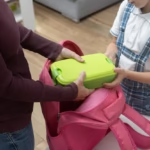
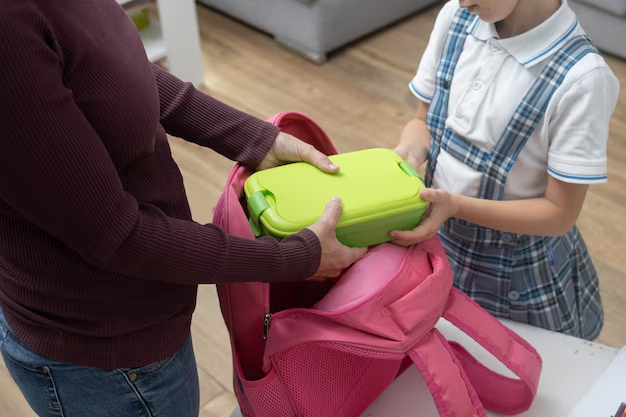
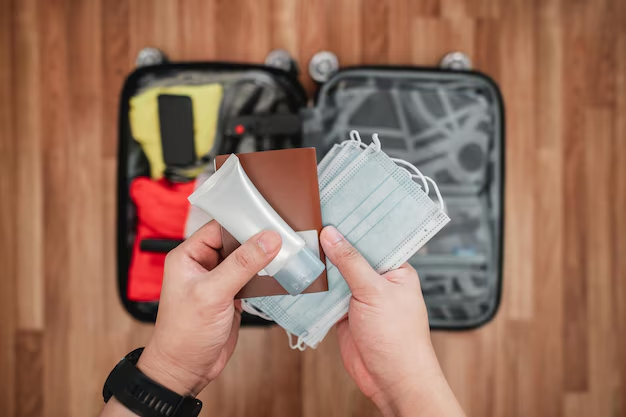
You should have an emergency bag or at least a small backpack “in case of an alert.” It’s worth putting there:
- documents (originals or copies),
- water,
- medicines,
- power bank,
- flashlight,
- snack (bars, nuts, dried fruits),
- warm clothes or raincoat,
- towel or napkins. It doesn’t necessarily have to be the perfect set — the main thing is that it exists and is always nearby.
Think through the route to the nearest shelter
Where will you go if an air raid alert catches you at home, at work, at a shopping mall, in a car, at school? In advance, find shelter locations, practice reaching them without hurry. If these are children — show the route and discuss “what to do if…” in the form of a game.
Teach those who are weaker than you
Children, elderly relatives, people with disabilities — they need not so much instructions as support. Become a guide for them. Show that you know what to do. In such moments, an adult’s confidence is the best instruction for a child.
Find your 5 minutes of “readiness”
Prepare the shelter: bring water, a blanket, books, coloring books for children, a small first aid kit there. Think about how to fill time in silence — this reduces anxiety. And then, when it gets loud — you’ll have an “island of calm.”
Let’s repeat: civil protection is not difficult. It’s a habit. And every habit starts with the first time. Choose the path of not being helpless in a crisis situation.
Your attentiveness = your life
In modern warfare, there is no “rear” where you can relax completely. Shaheds don’t ask for permission at all and don’t choose only military targets. They hit residential buildings, schools, thermal power plants, hospitals. But while air defense is working above us — we have time. And this time shouldn’t be wasted.
Attentiveness is not fear. It’s strength. It’s readiness to act quickly, intelligently, and confidently. It’s knowledge that turns into automatism, not panic. And most importantly — it’s your contribution to common security. Because one who hasn’t fallen into panic can support someone nearby. And this is already a rescue chain.
Now you know how a Shahed sounds. You know what to do when you hear this sound. And you know that your action is the first line of defense!