

The most frightening thing isn’t what’s already visible. The most frightening thing is what flies silently, unnoticed, from the sky. And while cameras on towers, motion sensors, or armored doors secure the ground, the drone chooses a different axis of attack — vertical. It isn’t stopped by a fence. It doesn’t trigger alarms, doesn’t bang on windows. It simply flies — and by the moment you notice it, it’s too late to do anything.
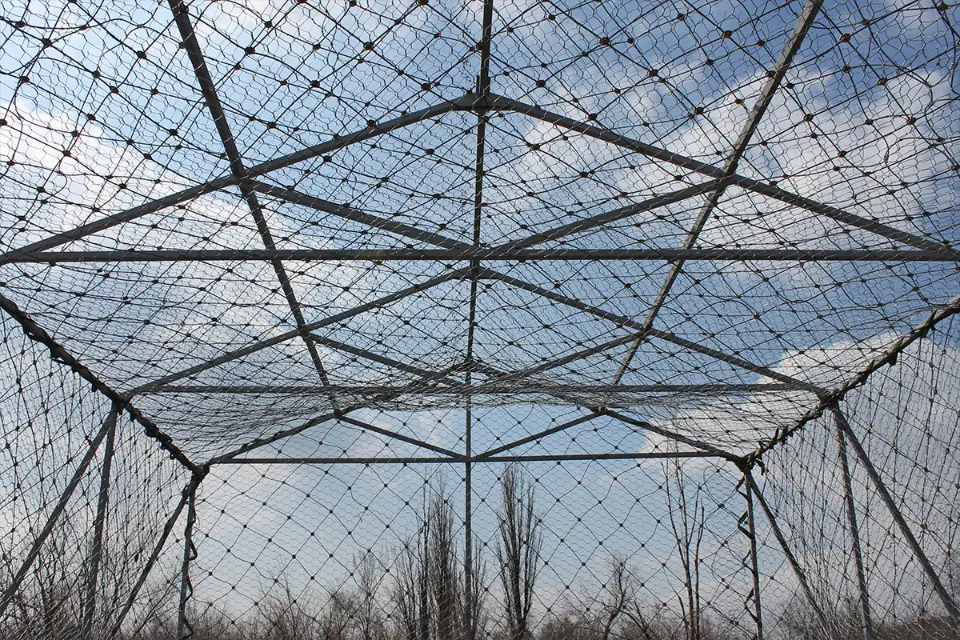
This is why anti-drone nets appear on rooftops, in courtyards, above entrances. Steel rods. Cables stretched between walls. Reinforced structures that seem to hover above concrete shelters. Hence the question: does this work? Can a net protect against a threat that operates in “here and now” mode? Or is it a visual illusion of security?
What is an Anti-Drone Net and How Should It Work?
In the simplest sense, an anti-drone net is a mechanical barrier between a drone and an object. Its task is to physically prevent the UAV from reaching its target, disrupt its trajectory, or force an explosion to occur “on approach” rather than at the destination point. Ideally, it should also absorb part of the blast wave.
Nets can be different:
- Metal grids, welded on-site or mounted on frames,
- Cable structures stretched in a checkerboard pattern,
- Modular barriers made of reinforced panels or steel pipes.
But their entire essence is in the moment. The drone must fall into a “trap” or catch on a protrusion. And then either fall or detonate away from the main target. That’s why a net isn’t protection in the classical sense. It’s an attempt to win a few critical meters or a few seconds.
The Advantage: Simplicity and Time
This is the power of nets — in their banality. They can be installed quickly. No electricity, server, software, or artificial intelligence specialist is needed. This is the simplest countermeasure against drone threats, available even in “field” conditions.
A net doesn’t require regular maintenance. It’s visible from afar — and this is already a psychological signal that the target hasn’t been left unattended. In areas without stable electricity or where there are no sensor systems — this is often the only thing that can be done here and now.
Limitations That Cannot Be Ignored
A net cannot protect against everything. FPV drones — small, fast, maneuverable — often fly between the rods or simply choose another trajectory. The explosive force, even if the drone catches on the net, is still transferred to the surrounding surfaces. If the structure isn’t designed to absorb impact — the damage will be no less than without a net.
You need to correctly calculate:
- The distance from the roof to the target,
- The density of the net,
- The possible angle of the drone’s approach,
- The height of the barrier placement.
Also, not all buildings can be covered. Architecture, technical requirements, legal restrictions — all these complicate implementation.
Mechanical Alternatives: Antennas, Protrusions, Superstructures
In some cities, especially closer to the combat zone, metal “horns” on roofs have begun to appear, systems of thick reinforcing bars arranged vertically or at an angle. Superstructures made from profiles, folding grids, or canopies over generators, communication nodes, and ventilation are also used.
This is an attempt to transform an ideal surface for hits into a zone of unpredictability. The more protrusions and irregularities in the surface — the harder it is for a drone to accurately “land” at the desired point. And although these methods don’t replace electronic drone detection, they work in combination — creating an additional “layer of protection.”
Where Nets Are Truly Effective
Conditions where anti-drone nets are justified and effective are:
- Humanitarian points where there are many people and no air defense;
- Energy or communication nodes operating under limited security conditions;
- Logistical warehouses that can technically be covered and where an explosion above the roof is better than a hit to fuel or doors.
These are also temporary shelters, mobile hospitals, volunteer centers — anything where the risk exists but there are no electronic means or time for their implementation.
Why We Install Them: An Honest Answer
We don’t install nets to stop drones. We install nets so that drones lose their ideal trajectory. So that the explosion is a bit farther away. So that somewhere nearby there are fewer fragments. Sometimes a net is the only chance to win two seconds that save lives.
Yes, this isn’t a solution that replaces electronic warfare, projectors, thermal imagers, or air defense. But it’s a solution that works where nothing else is fast enough. This is defense that can be welded in a garage but that withstands impact better than the enemy expected.
Not a perfect shield, but better than nothing.
Anti-drone nets aren’t a technological miracle. They’re a smart, limited, but working response to a real threat. They won’t make an object invulnerable, but they can intercept a fatal trajectory.
In a war where time is often the main resource, even a few seconds, even a few meters — it’s the difference between “almost” and “survived.” And for this reason, it’s sometimes worth stretching a few cables between walls.