

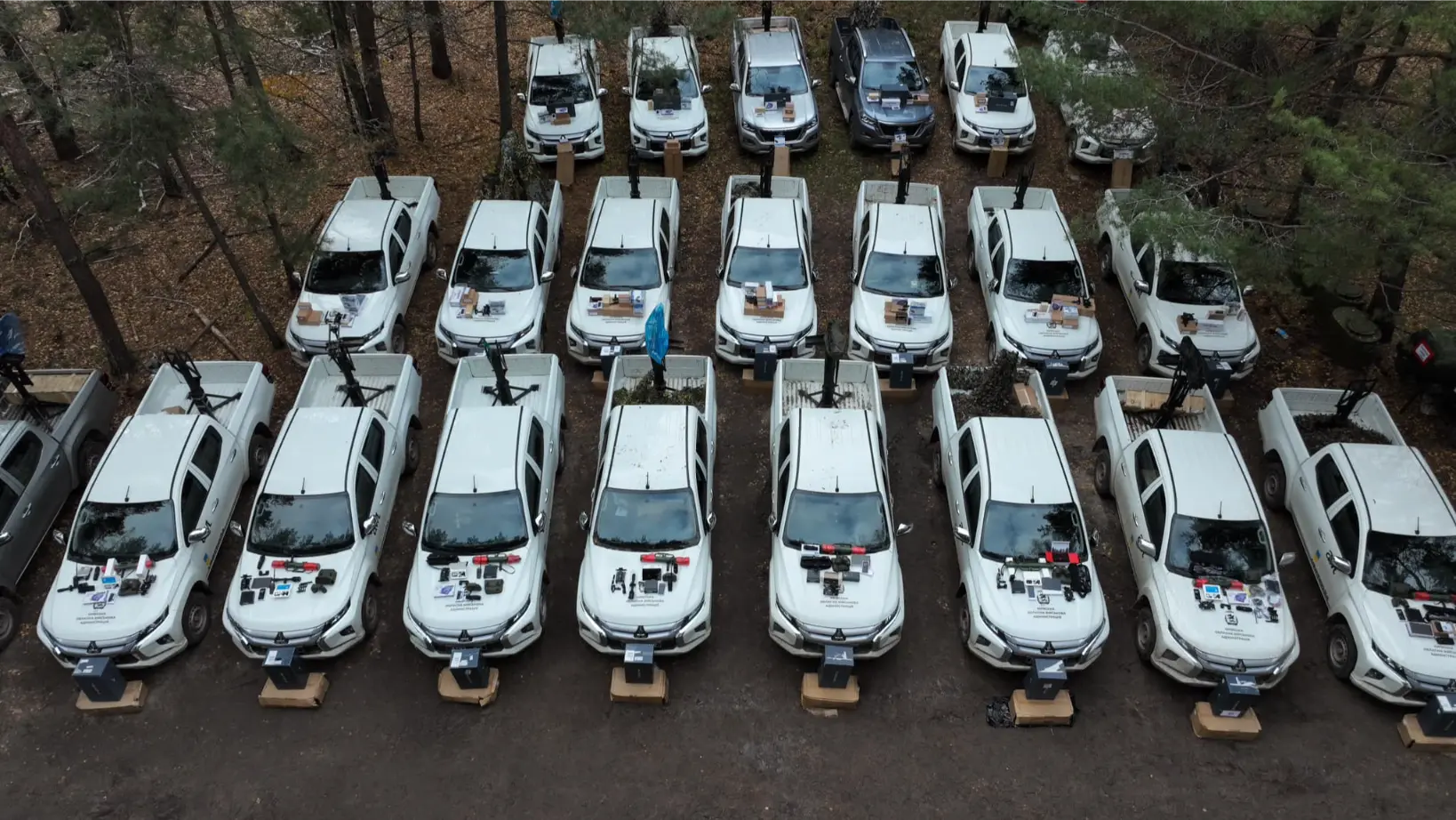
In 2024, the main focus in drone countermeasures shifted from large air defense complexes to local solutions capable of responding quickly and with mobility. The enemy attacks not only frontline zones but also the deep rear. Mobile fire groups have become the most effective response — teams that can change location in minutes, detect an aerial target, obtain coordinates — and act.
Their effectiveness is based not only on the human factor. Early detection technology plays an important role — particularly thermal imagers, radars, laser and anti-aircraft spotlights, which allow drones to be seen at night, against obstacles, or in difficult weather conditions.
What has changed in approaches to mobile defense
Unlike 2022, when a mobile group was often a pickup truck with a machine gun, today it’s about a full-fledged platform that works proactively. On board there may be:
- short-range radar,
- thermal imaging module,
- powerful spotlight,
- laser for blinding FPV optics,
- anti-drone rifle or REB module.
The operator doesn’t work “by eye.” He sees where the drone is coming from, what trajectory it chooses, how fast it moves. At night, it’s critically important to “illuminate” an aerial target in time. Anti-aircraft spotlights play a key role here — without them, thermal imagers lose effectiveness at long distances.
How lasers and spotlights are used
In mobile groups, the laser module works in tandem with a thermal imager. When a drone appears on the screen, the operator directs the beam to the point where the camera or sensors are located. After a few seconds of exposure, the drone loses its “vision” and stops orienting itself. This is especially effective for FPV drones, which depend on visual communication with the operator.
Spotlights are used for:
- detecting targets against complex terrain,
- visual tracking,
- signaling to the rest of the group that the drone is in the field of action.
Some platforms use a system where the spotlight automatically “catches” the target after confirmation from the radar. This allows coordinating the action of several vehicles or working synchronously with the REB module.
City protection: how to adapt with limited resources
In small communities or on the outskirts of cities where there are no air defense systems, mobile fire groups have become the main form of city protection. They don’t wait for orders from above — they patrol, monitor the air, respond in real time. Using early detection systems that can be placed in a trunk, on a car roof, or on a tower — allows them to be one step ahead.
In some cities, even volunteer mobile groups are being created, coordinating their work with Territorial Defense Forces. Available technology, such as the LaserGuard spotlight, connects to generators and becomes the night eye of the community, seeing threats before they can be heard.
2024: the year when flexibility is more important than scale
Front-line experience has shown: victory isn’t always brought by large equipment. Often, a key role is played by a small, mobile group that knows where to look and has the means to respond.
Security systems have changed:
- Not size — but speed.
- Not weight — but precision.
- Not a command post — but a machine that sees in the dark.
This is how a new logic of defense is formed. And this is how mobile groups become not a “reserve,” but the first line of defense in the rear.