
In recent years, drones have become a common element in warfare, security, surveillance — and simultaneously a new security challenge. If previously they were mainly used for video recording or delivery, today UAVs can strike targets, correct fire, conduct surveillance, or carry explosives. And most importantly — they are accessible, maneuverable, and difficult to predict.
Traditional security systems — cameras, alarms, even physical security — cannot respond quickly enough to threats coming from the sky at speeds of 100 km/h. That’s why “after the fact” approaches are being replaced by active drone neutralization measures.
One of the most effective solutions already used on the front lines, in the protection of strategic facilities, and even in the private sector — is the anti-drone gun. It doesn’t fire bullets, but disables the target. It doesn’t cause an explosion, but stops the threat. And that’s why it has become a symbol of a new era of defense — where the main weapons are frequency, precision, and reaction time.
What is an Anti-Drone Gun: A Simple Definition
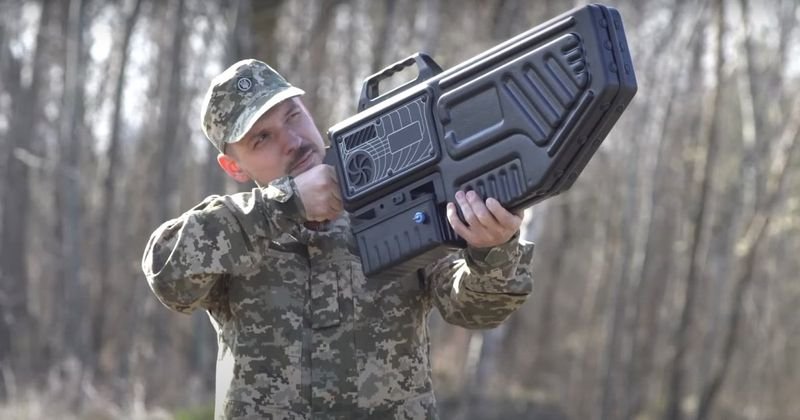
An anti-drone gun is a specialized electronic warfare device created to interrupt the connection between a drone and its operator. It outwardly resembles a regular rifle or shotgun, but inside — it’s not a weapon in the traditional sense. It doesn’t fire bullets, doesn’t have combat ammunition, and doesn’t use physical force. Its “charge” is directed radio frequency radiation.
Figuratively speaking, an anti-drone gun is a “jammer in targeting form.” The operator aims it at the target and pulls the “trigger” — the system begins to emit signals that jam the drone’s communication channels, including:
- the control channel between the drone and its operator (RC or Wi-Fi),
- the video or telemetry transmission channel,
- GPS/GLONASS signals responsible for navigation.
As a result, the drone loses orientation, signal, or command. And this means — it hovers, returns to the launch point, or simply “lands” at the nearest available point. No explosion. No physical contact. Only precise, directed interference with the drone’s “brain.”
What are its advantages?
- Works without harm to people or surrounding objects.
- Doesn’t require special permits for combat use (depending on jurisdiction).
- Has an immediate effect if the drone is within range.
Anti-drone guns are tools created for a new type of warfare and new security. They show that modern defense is not just about bullets, but also about waves. And that victory in the air today depends not only on strength, but also on frequency, precision, and intelligent technology.
How Exactly an Anti-Drone Gun Works: Technology in Detail
The heart of any anti-drone gun is a set of directional antennas and transmitters that create a “stream of radio-electronic noise” toward the target. The task of this noise is to prevent the drone from “hearing” its signals, specifically control signals, navigation, or video transmission.
- Radio Frequency Jamming
When an operator aims the anti-drone gun at a target and turns it on, active radiation begins on several frequencies simultaneously:
- 2.4 GHz / 5.8 GHz — the most common communication channels between the drone and remote control;
- GPS / GLONASS / Galileo — global navigation signals responsible for course;
- sometimes — LTE / Wi-Fi, if the drone transmits video in real time.
This radiation doesn’t destroy the drone but interrupts its ability to orient itself in space. Its “ears” are plugged.
- What Happens to the Drone After Jamming
The drone’s behavior depends on its settings and model. After signal loss, the following scenarios are possible:
- Automatic return to the starting point (RTH): common in commercial and “smart” military models.
- Emergency landing: the drone “understands” it’s blind and deaf, and descends.
- Freezing in the air: hovers in place, having lost all coordinates — most often this is how drones without RTH algorithms behave.
- Unstable drifting: especially relevant for FPV drones — they don’t have GPS and can simply “float” until they fall.
Is it safe?
Yes, an anti-drone gun doesn’t physically destroy the device, making it safer for civilians. It doesn’t cause an explosion or provoke uncontrolled falling, like air defense systems.
But the operator must be trained — careless jamming can “land” a drone on a roof, in a crowd, or at another critical point. Therefore, accuracy, experience, and strategy of use are key.
Types of Anti-Drone Guns and Their Effectiveness
Today, dozens of anti-drone gun models are on the market. They differ in shape, range, jamming frequencies, weight, power type, but are united by one goal — to effectively and safely neutralize UAVs.
Tactical Models (Combat Conditions)
Designed for use by military, mobile fire groups, special services. Examples: DroneGun Tactical (Australia), EDM4S SkyWiper (Lithuania), DroneDefender (USA).
Characteristics:
- Range: up to 2 km
- Jamming frequencies: up to 4-5 channels
- Weight: 5-7 kg
- Work in conjunction with thermal imagers, radars, or visual observation.
Portable Light Models (for Facility Protection)
Created for use by security guards, police, critical infrastructure services.
Characteristics:
- Range: 300-700 m
- Weight: 2-4 kg
- Power: built-in batteries
- Often work autonomously or as part of an “anti-drone shield.”
Stationary or Modular Solutions
Installed on masts, roofs, combat platforms. Work automatically or remotely.
Characteristics:
- Integration with radars, spotlights, air defense
- Can cover up to 360°
- Used to protect strategic facilities, borders, ammunition depots.
Solutions from LaserGuard Systems
In response to the Ukrainian Armed Forces’ need for effective drone countermeasures, LaserGuard Systems has developed its compact electronic warfare module, which works on the same principle as an anti-drone gun — interrupts drone control, blocks communication and navigation signals.
Features of the LaserGuard solution:
- Compactness and mobility — can be placed on various platforms or used manually
- Works on key frequencies: GPS, 2.4 GHz, 5.8 GHz
- Can be used as a separate gun or as a module within the overall LaserGuard system (along with thermal imaging, laser, spotlight).
Advantages:
- High efficiency at short and medium distances
- Ease of operator training
- Possibility of customization for specific tasks (military, border, civilian).
This solution ideally combines with other LaserGuard Systems modules, creating a unified protection circuit — from detection to neutralization. And most importantly — it already works in practice, not just in the laboratory.
Areas of Application: From the Front Line to Critical Infrastructure
Anti-drone guns have long ceased to be “highly specialized weapons for the military.” Today, this is a flexible tool used in dozens of different environments — from hot spots to civilian infrastructure facilities in the rear.
- Military Operations
Anti-drone guns are actively used as part of mobile fire groups — these units intercept FPV drones, Shaheds, reconnaissance UAVs that try to detect positions, transmit coordinates, or strike.
Advantages:
- Immediate reaction,
- Ability to “take down” a drone without explosion,
- Safe use in personnel concentration areas.
- Critical Infrastructure
Oil depots, logistics hubs, power plants, reservoirs — all these are target #1 for reconnaissance drones and sabotage UAVs. An anti-drone gun can be an effective last line of defense when a drone is already in sight.
Usage:
- On guard towers or roofs,
- In conjunction with radars and spotlights,
- As part of an “anti-drone dome.”
- Border Territories and Perimeter Protection
Reconnaissance drones increasingly violate state borders — both for military purposes and for smuggling. Anti-drone guns are effectively used by border guards and security services, particularly for suppressing drones before they cross key boundaries.
- Security for Mass Events and VIP Locations
Forums, political meetings, concerts, sporting events — are increasingly provided with “anti-drone protection.” Guns work as a point means of neutralization when detecting unauthorized flights over crowds.
- Private Sector and High-Risk Objects
Owners of private estates, companies, or agricultural enterprises also turn to anti-drone measures to protect the airspace above their property. This is not just about aerial photography, but also about possible attempts to collect commercial information or surveillance.
An anti-drone gun is a universal tool. Its strength lies in mobility, ease of use, and instant reaction. It doesn’t replace the entire security system but becomes a critical link where seconds matter.
Anti-Drone Gun as Part of a Security System
Despite its name, an anti-drone gun is not an independent “magic wand” that solves all problems. Its maximum effectiveness is revealed only when it is part of a comprehensive surveillance and response system.
Integration into the Architecture of an “Anti-Drone Dome”
In modern solutions, particularly those implemented by LaserGuard Systems, the gun serves as a rapid response tool — but only after the target is detected by other components:
- radar or thermal imager — detects UAVs on approach;
- spotlight or optical system — “catches” the target in the field of view;
- anti-drone gun — performs targeted radio jamming.
This approach reduces the number of false alarms, doesn’t waste resources on targets beyond the scope of real threat, and optimizes the operator’s work, as they don’t “search” but “strike.”
Autonomous vs. Manual Systems
LaserGuard systems can work as manual solutions (mobile gun with operator) or integrated modules that activate automatically after target detection.
The autonomous model is particularly useful at facilities where it’s not possible to keep a team on duty constantly, but it’s important to have a neutralization tool “at the ready.”
In modern drone confrontation, speed and system coherence are key advantages. And that’s why an anti-drone gun should not be a “separate gadget,” but an element of digital security architecture that sees, accompanies, evaluates — and only then strikes.
Myths and Reality: What It Can and Cannot Do
With the growing popularity of anti-drone guns, many exaggerations have appeared around them. They are often presented as a “wonder weapon” that instantly destroys any UAV — regardless of size, height, or protection. In reality, it’s a bit more complex — and more technological.
- Myth 1: An anti-drone gun “shoots down” a drone
Reality: The gun doesn’t physically destroy; it jams the signal controlling the drone. As a result, the UAV loses connection with the operator and lands, hovers, or returns — depending on the settings.
- Myth 2: It works the same on all types of drones
Reality: Effectiveness depends on the type of drone, its navigation, protection of communication channels. Some FPV drones don’t have GPS and may be less sensitive to certain frequencies.
- Myth 3: You can “just pick it up and use it”
Reality: Effective operation requires operator training — knowing where to aim, how long to hold the signal, in which conditions jamming is effective.
- Myth 4: An anti-drone gun is a panacea
Reality: The gun is just one element of the security system, which works best in conjunction with radars, visual modules, and analytics.
Anti-Drone Gun — a Point of Strength in the New War
Today, war and security are conducted not only “on the ground”; they begin in the air. And a drone is no longer an innovation but a routine threat that needs to be dealt with daily. An anti-drone gun is a tool for quick, targeted, contactless countermeasures that:
- doesn’t require artillery or missiles,
- doesn’t create additional danger around,
- doesn’t wait for orders — acts instantly.
It is especially valuable in places where air defense cannot be installed, or where drones appear unexpectedly: in border areas, warehouses, during evacuations, at infrastructure facilities.
And most importantly — it becomes even more effective when it is part of an intelligent security system, such as LaserGuard. Where everything works together — from detection to response — drones don’t stand a chance.