
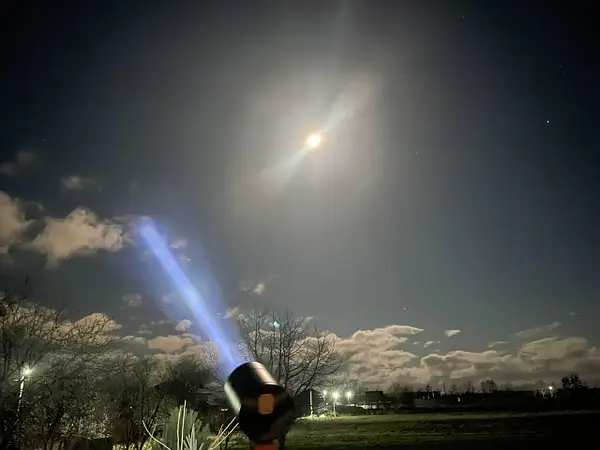
Night. Air raid alert. The siren in the darkness seems many times louder than during the day. Fear grows because nothing is visible. And it’s in these minutes that a searchlight in the sky becomes not just technology — it becomes a point of support. Light that cuts through the night means: we are seen, we are protected, the system works.
At a time when the air threat is real, and UAVs attack cities, infrastructure, and even schools — spotlights are transformed into a tool for observation, navigation, alert, and action. This beam of light often precedes the alarm and helps accurately localize the target. And that’s what we’ll talk about — in simple words about the complex light that saves.
How target illumination works
Illumination is not just “to see better.” It’s part of a multi-level UAV countermeasure system. When a spotlight focuses on an object in the sky, it helps air defense better identify the target, keep it in sight, and respond with maximum precision.
Most often, spotlights are used at night when other sensors have limited visibility. For example, detecting a Shahed at a distance of several kilometers at night is possible not thanks to cameras, but precisely due to thermal imagers and spotlights. The spotlight “catches” the target in the beam, holds it, transmits data, and allows air defense operators to work more accurately.
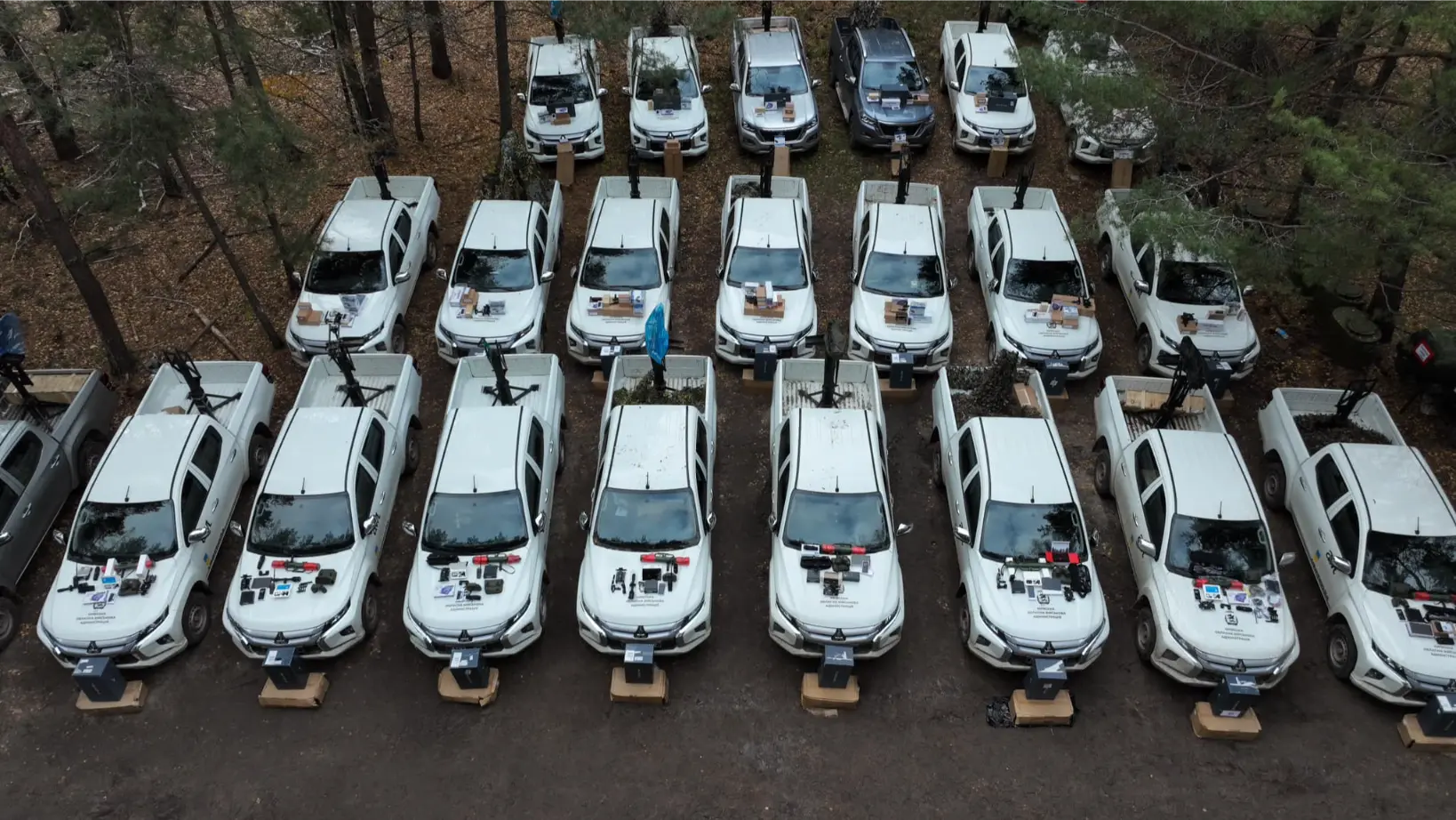
These aren’t necessarily complex technologies — in many cases, spotlights are installed even on mobile fire groups. Sometimes — simply on the roof of a building. But the effect is the same: visible light gives an understanding of where the target is and where to direct the response.
Spotlight as part of the surveillance system
A separate spotlight is just bright light. But in conjunction with other components of the security system, it becomes a real “eye” that sees the threat before it approaches.
Spotlights work together with:
- radars (which detect an air object),
- thermal imagers (which determine the heat source),
- video surveillance systems (which provide images),
- and, finally, with the air defense system itself (which responds).
Without illumination, the operator sees only signals on the screen. But with a spotlight — they see the real target, its trajectory, speed, point of impact. And most importantly, they do this in conditions when the camera is “blind” and the night is impenetrable.
What types of spotlights are there: explaining simply
At first glance, spotlights are just a source of light. But when it comes to detecting air threats, especially drones, they become a tool for navigation, target designation, and even direct countermeasures. Three types are most commonly used: anti-aircraft, search, and laser spotlights. And each of them has its place, its function — and its limits of capabilities.
Anti-aircraft searchlight
What it’s for: Used to illuminate airspace during night attacks, especially when detecting UAVs flying at low altitude.
Advantages:
- Long illumination range (up to several kilometers).
- The beam is visible from a great distance — psychological effect of presence.
- Works even in poor visibility (fog, dust).
Limitations:
- By itself, it doesn’t “see” the target — requires coordination with radar.
- Vulnerable to enemy electronic warfare means, can be a revealing factor.
- Large in size, requires infrastructure for installation.
Search spotlight
What it’s for: Designed for localization, tracking, and fixing a specific object. Often used on mobile platforms or in mobile groups.
Advantages:
- Mobility — can be installed on a car, roof, tower.
- Works well in conjunction with thermal imagers and cameras.
- Keeps the object in the beam, facilitating navigation for air defense or the operator.
Limitations:
- Smaller radius of action than an anti-aircraft spotlight.
- Requires constant control or automatic guidance.
- Doesn’t work independently — always part of a system.
Laser spotlight / laser illumination system
What it’s for: This is the most modern and functional type of spotlight, which not only illuminates the target but physically affects it. Its beam can blind a drone’s camera, interfere with navigation, or even disable sensitive UAV elements.
Advantages:
- Instant reaction — the beam works at the speed of light.
- Directed action — minimum collateral illumination.
- Invisible spectrum possible — the target doesn’t always understand that it’s being “tracked.”
- Can be integrated into the air defense system or work autonomously.
- Doesn’t completely reveal the object, like traditional light.
Limitations:
- More expensive to produce and maintain.
- Requires precise aiming.
- May be sensitive to weather conditions (depending on the type of laser).
- Not all drones are equally vulnerable to laser influence.
Comparison table of spotlight types
| Parameter | Anti-aircraft | Search | Laser |
| Range | ★★★★☆ | ★★★☆☆ | ★★★☆☆ – ★★★★★ |
| Mobility | ★☆☆☆☆ | ★★★★★ | ★★★★☆ |
| Accuracy | ★★☆☆☆ | ★★★★☆ | ★★★★★ |
| Physical impact on UAV | ✘ | ✘ | ✔ |
| Autonomous operation | ✘ | ✘ | ✔ (in new models) |
| Cost | ★★☆☆☆ | ★★★☆☆ | ★★★★★ |
What’s the main difference? Ordinary spotlights provide the ability to “see.” A laser spotlight is already action. It doesn’t just shine, it counteracts. This is not a passive reaction, this is active intervention. And it’s precisely these systems that represent the future in the field of UAV countermeasures.
Light against panic: the effect of presence
When darkness surrounds, fear multiplies. Because we’re not afraid of the strike itself — we’re afraid of the unknown. And it’s in such moments that a spotlight in the sky becomes a sign for people: “we are seen, we are protected.” This simple light creates the effect of defense presence even where you don’t see anyone.
A spotlight is not only for air defense, it’s also reassuring for people. A person who sees a light beam instinctively understands: there’s a system, there’s control, there’s a response to the threat. This is calming. Especially for children, elderly people, those who have experienced previous shellings. Light doesn’t just cut through the night, it restores the feeling of security.
Examples from real situations:
- In a small community in southern Ukraine, after installing a spotlight, residents came out on the street after the all-clear for the first time in many months because they knew: above them is a controlled zone.
- In one of the port cities, where people previously hid in darkness, after launching laser illumination of drones, panic significantly decreased, and the level of community coordination during alerts increased.
For whom is this critically important:
- Educational institutions — children need to know that protection works.
- Logistics and transport facilities — chaos among personnel is dangerous in itself.
- Medical facilities and evacuation hubs — staff calmness = coordinated work.
- Communities in border areas — here the feeling of “we’ve been abandoned” is particularly strong.
In modern warfare, security is not only about technology. It’s also about psychology. And a spotlight that shines through darkness is a signal: We are here. We see. We protect.
Why investing in spotlights is a solution, not an expense
Everything related to security sooner or later faces a simple question: is it justified? In the case of spotlights, the answer is very straightforward: yes.
First, it’s a relatively inexpensive component of the overall surveillance system. A spotlight costs less than a camera with a thermal imager or an air defense system but enhances their effectiveness.
Second, it doesn’t require a large team for maintenance. Modern models work autonomously, respond to signals, or act in sync with radars. This minimizes the human factor.
Third, a spotlight can be quickly installed, even in field conditions, on mobile firing points, roofs, towers. There’s no need for complex infrastructure.
And most importantly — it’s an investment not only in “illuminating” but in seeing in time, responding in time, saving in time.
Better warning light than blind panic
At a time when nighttime silence can change to the hum of drones, light becomes a general necessity. Therefore, a spotlight is not just technology. It’s a position. A position of readiness, responsibility, strength. It doesn’t cancel the alarm. But it gives a chance to see the threat first. To respond. To maintain control. And often this is enough to preserve what’s important.
Light is a sign. And today we decide for ourselves what exactly it means: fear — or protection.